Lawyers in India need capacity, not software
A survey by the Vidhi Centre for Legal Policy — covering 2,800 advocates across eight High Courts — found that 79% of advocates in their first two years of practice earn under ₹10,000 a month. At the High Courts of Allahabad, Bombay, Kerala, Madras, and Patna, nearly half the respondents said a young advocate's monthly income falls somewhere between ₹5,000 and ₹20,000.
At ₹10,000 a month, you are not hiring a junior associate or retaining a clerk or subscribing to a research database that costs more than your rent. You are handling everything yourself — the court appearances, the client meetings, the research, the drafting, the filing, the follow-ups — because there is nobody else to hand it to. The Bar Council of India recognized as much in October 2024, when it recommended a minimum stipend of ₹20,000 per month for junior advocates in urban areas and ₹15,000 in rural areas, a recommendation that is, notably, non-binding. The profession's own governing body is acknowledging that most young lawyers cannot sustain themselves, and the best it can offer is a suggestion.
Where the Hours Go
If you are a solo practitioner, the most expensive thing you spend is not money — it is time, and the largest share of it goes to research.
Lawyers spend roughly a third of their working hours on legal research alone — about 15 hours every week. That is 15 hours spent going through case law databases, reading judgment after judgment to find the one that applies, pulling up statutes section by section, checking whether an amendment has changed the position, and so on. This is painstaking, essential work, and it cannot be skipped — a missed precedent or an outdated section reference does not just weaken your argument, it can cost your client the case.
But those 15 hours are also hours you are not in court, not meeting a potential new client, not drafting the application that has been sitting on your desk for three days. For a solo advocate juggling multiple matters, every hour spent in research is an hour borrowed from something else, and the constraint is never skill or knowledge — it is the number of hours in a day.
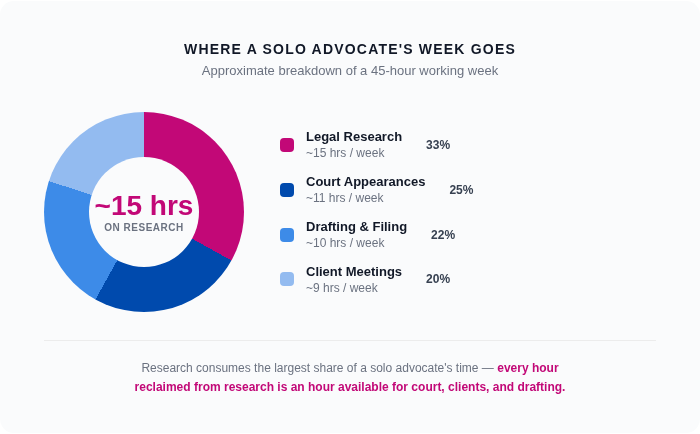 A solo advocate's time is split between court, clients, and research — with research consuming the largest share.
This is why the conversation about legal technology in India has been missing the point. The profession does not need another tool or a shinier interface on the same keyword search. What it needs is more capacity — more hours of productive output from the same person, without requiring them to hire people they cannot afford.
What Six Users Showed Us in Eight Days
Miss Lucy launched a few weeks ago. We are not a company with thousands of users and years of data — we are three co-founders with a product we believe in and a small group of early users who have been putting it through its paces.
In the last eight days, six of our most active users gave us something we did not expect: a window into what capacity actually looks like when it is multiplied.
These six users asked Miss Lucy their questions, uploaded their documents, and worked through their legal problems the way they would with any colleague. Miss Lucy executed over 1,100 research operations on their behalf in those eight days — searching case law across multiple databases, pulling specific paragraphs from judgments, looking up statutes section by section, checking gazette notifications for amendments, reading and analysing uploaded documents, cross-referencing findings, and generating structured legal analyses and downloadable documents.
We did some rough, back-of-the-envelope arithmetic. For each hour a user spent working with Miss Lucy — asking questions, reading her responses, refining her analysis — the equivalent output, if done manually, would have taken approximately ten hours. That is ten hours of work that a research associate does, day in and day out, in a well-resourced law firm.
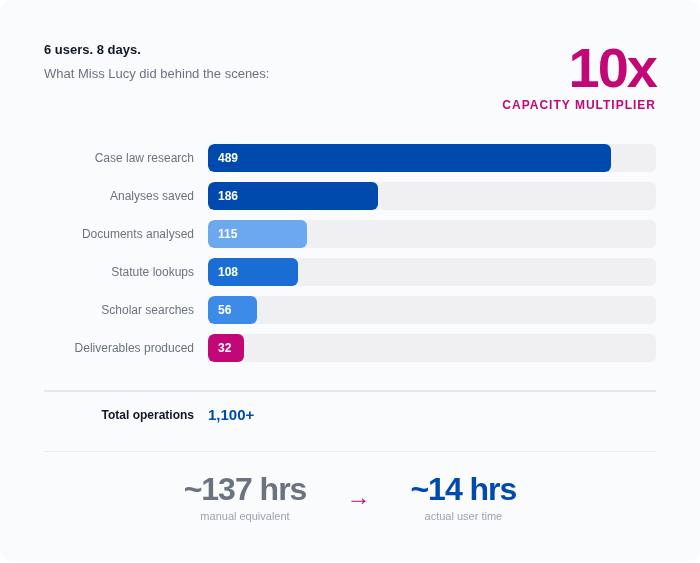 For every hour spent with Miss Lucy, users got the equivalent of ten hours of manual research output.
This is not a laboratory benchmark or a theoretical projection. It is what six real users, working on real legal problems, actually experienced in their first week with the product.
What 10x Means for a Solo Advocate
Consider what this means for the advocate earning ₹10,000 a month.
She is spending 15 hours a week on research — a third of her working life. If she could compress that research into a tenth of the time, she would not merely save a few hours — she would reclaim an entire dimension of her practice that was previously inaccessible. Instead of handling three matters because that is all her hours allow, she could handle eight. Instead of choosing between research and drafting on a given afternoon, she could do both. Instead of turning away a potential client because she does not have the bandwidth, she could take the brief.
More matters means more income — not because the billing rate has changed, but because the volume of work a single person can handle has fundamentally shifted. This is how Indian businesses have closed gaps with the rest of the world in every industry — IT services, manufacturing, pharmaceuticals — not through higher margins, but through dramatically higher throughput per person. The solo advocate does not need to wait for celebrity cases or high-value retainers to build a viable practice. The demand for legal work at the lower and middle end of the judicial system is enormous — applications, notices, affidavits, filings, compliance reviews, contract drafts — and the bottleneck has never been demand, it has been the capacity of one person to meet it.
Capacity, Not Software
If you ran a factory and someone offered you ten times the output without ten times the workers or ten times the machinery, you would not call that a new tool — you would call it a miracle. That is what capacity means, and that is exactly what we need to turbocharge the legal profession if we have any hope of competing in the world order.
Miss Lucy is available to advocates and students who are not stuck in the old ways. She is in Beta, and you can take her for a spin.
I'm Ani, co-founder of Miss Lucy — India's first conversational legal intelligence partner. If you're a solo practitioner stretched thin, a young advocate trying to build a practice, or someone at a small firm doing the work of a much larger team — come see what capacity feels like at miss-lucy.in.
Ready to lead the Generation Leap?
Join the charter partners using Miss Lucy to transform Indian legal research.
Request Early Access