Most Legal AI Tools Have the Memory of a Goldfish
You spend forty minutes working through a problem with an AI tool. You push back on a bad answer, refine the question, and eventually get somewhere useful. Then you close the tab.
The next morning, you open it again and the AI has no idea who you are. You re-explain the case, the client, the jurisdiction. Every session starts from zero.
There is a second problem that gets less attention. During that forty-minute session, the tool was retrieving, not reasoning. You typed a question, it found a matching passage, and it handed it back in a nicer font. There was no deliberation about whether a particular section of a statute applies to your facts, or whether you should be looking at a different provision altogether. You got an answer with no way of knowing how it got there.
How Miss Lucy Reasons
When you ask Miss Lucy a legal question, she does not search for a matching paragraph and hand it back. She breaks the problem down.
If you ask whether a contract clause is enforceable, she considers the relevant statute, checks whether recent judgments have changed the position, looks at whether your specific state has additional requirements, and flags procedural complications that may not be obvious. Each of these steps is visible to you in real time. You can expand any step, read the reasoning behind it, and challenge it. If you say "but this agreement was signed before that judgment came out," she re-evaluates the analysis with that constraint factored in.
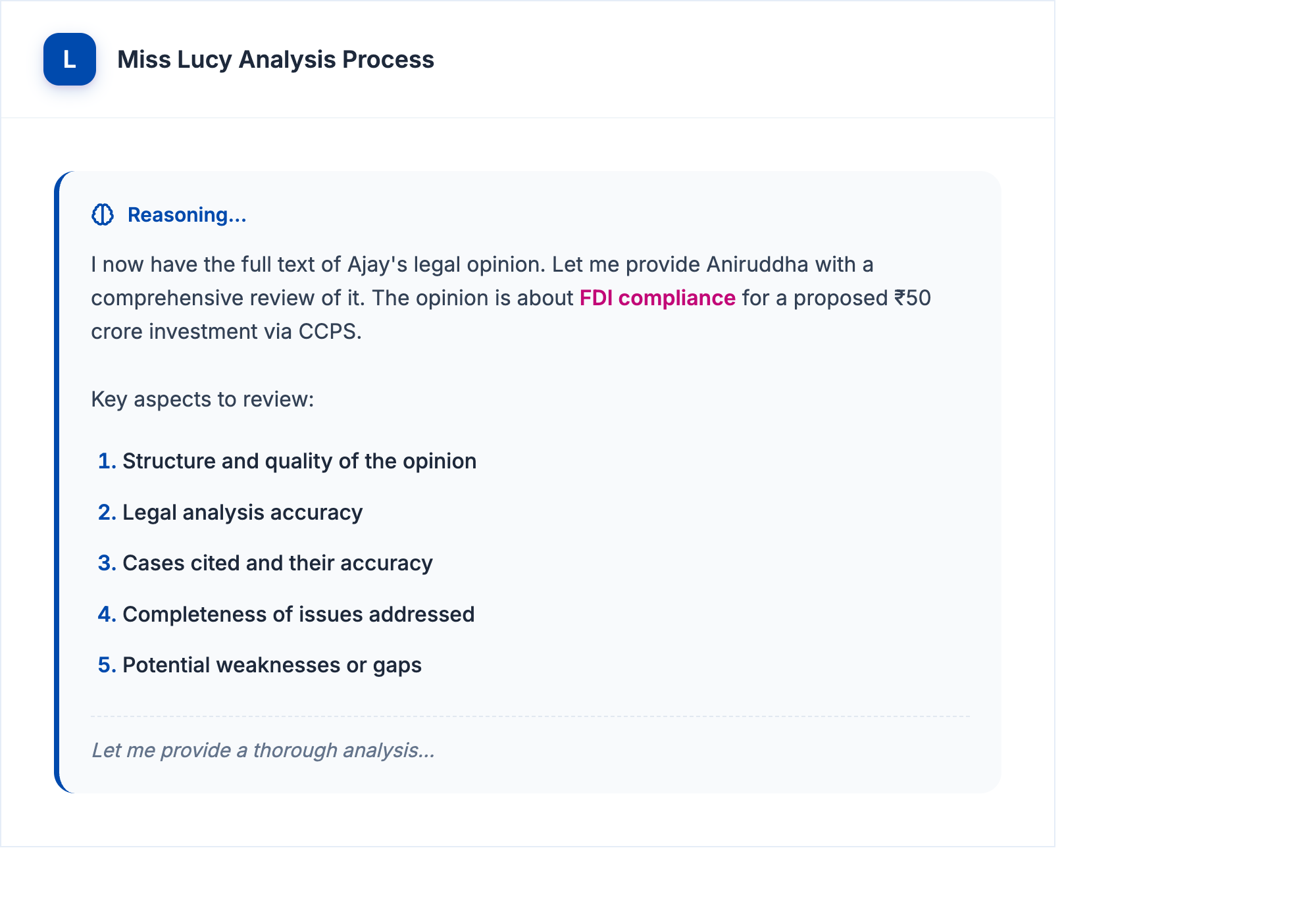 Miss Lucy decomposes complex legal queries into verifiable reasoning pillars.
For a practising advocate, this means the reasoning can be verified before it reaches a courtroom. For a law student, it means watching how a senior lawyer would approach a problem — considering multiple angles, weighing conflicting positions, and arriving at a view — except now you can see the entire process laid out, not just the conclusion.
How Miss Lucy Remembers
There are two problems with how AI handles memory, and most people only think about the first one.
The first is obvious: when a session ends, everything disappears. The conversation, the analysis, the context you spent an hour building — all gone. You start over the next day.
The second is less obvious but more important for legal work. Even within a single session, AI models do not read a document the way a lawyer does. They scan the beginning, the end, and build a general impression of what is in between. They pick up patterns and excerpts, not every word. For most applications, this is good enough. For legal work — where the placement of a single word in a clause can change its meaning — it is not.
This is why Miss Lucy saves her analysis incrementally as she works. When you upload a contract and ask her to analyze it, she works through it section by section. After each section, the analysis is stored permanently — the key clauses, the risk areas, the relevant case law, the specific language that matters. She does not rely on holding the entire document in her working memory, because that working memory has limits. Instead, each piece of analysis is saved to a structured, permanent record as she goes.
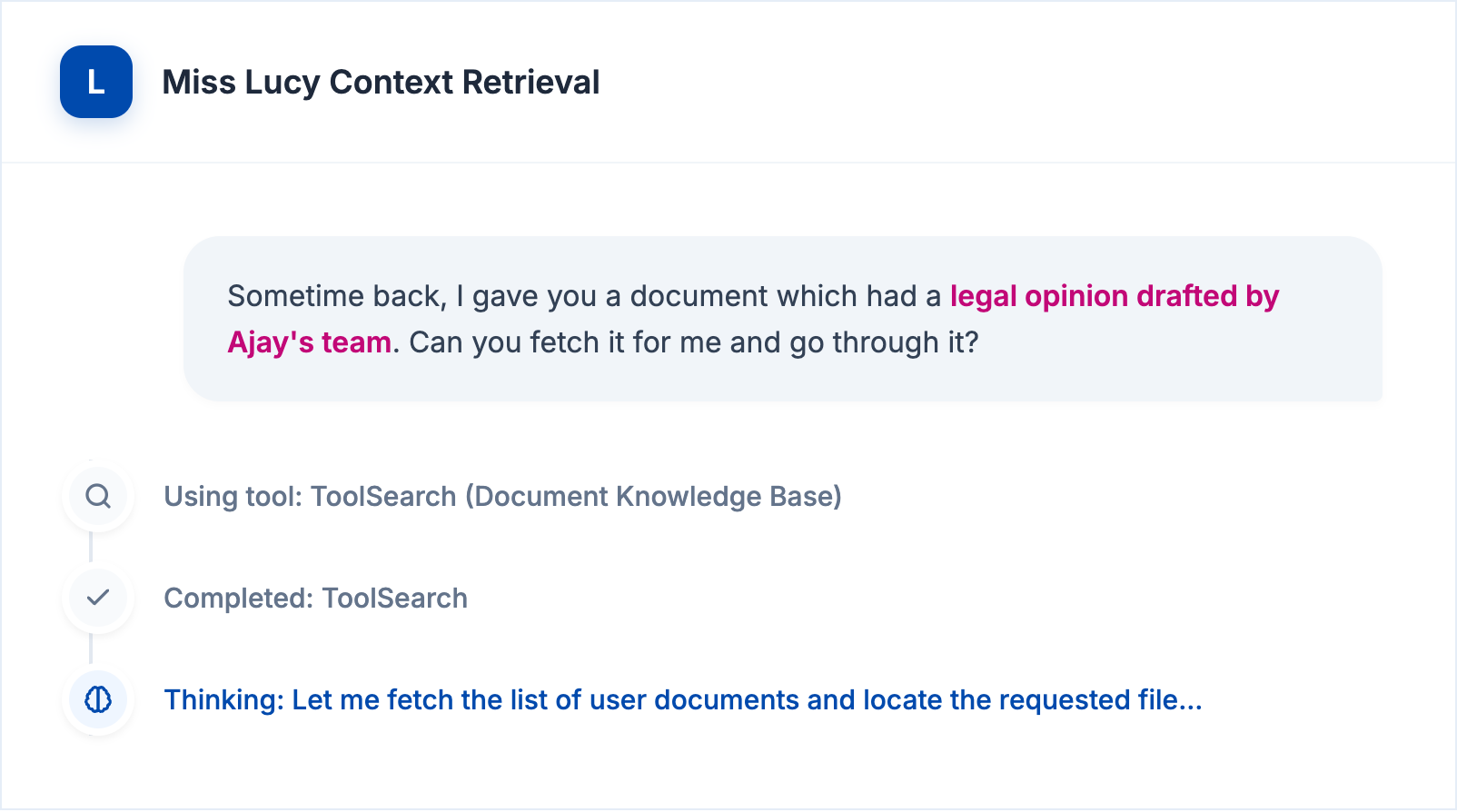 Miss Lucy maintains a long-term memory of your documents, allowing for seamless cross-session research.
The result is that when you come back three days later and say "draft a response based on what we discussed," Miss Lucy has the full context — not because she remembered it the way a human would, but because every step of the analysis was saved to a place where it cannot be lost. The research is organized, retrievable, and ready to use as the foundation for whatever comes next.
General-purpose chat tools do not have this infrastructure because they are not built for a specific profession. We built it because legal work demands that nothing is lost, missed, or approximated.
What Institutional Knowledge Really Means
A good lawyer becomes good by accumulating specific, small pieces of wisdom over years of practice. Knowing which bench of a High Court is more receptive to a particular kind of argument. Remembering that a counterparty used a specific delay tactic in a previous arbitration. Recognizing a nuance in a judgment that most people would read past. Understanding from experience that a particular contractual structure tends to fail under scrutiny in a specific jurisdiction.
This kind of knowledge takes a decade to build. It is not written in any textbook. It lives in the heads of senior partners and experienced associates, and it is what separates competent legal work from excellent legal work.
Now consider what happens if a 22-year-old law graduate, on their first day of practice, has access to a tool that has already accumulated this kind of structured knowledge — case law analysis, jurisdictional nuances, practical patterns — and can apply it to the specific problem in front of them. The gap between a first-year associate and a ten-year veteran does not disappear, but it narrows significantly. Multiply that across 70,000 graduates entering the workforce every year, in a system with 54 million pending cases and 15 judges per million people, and the compounding effect on the quality of legal help in the country becomes substantial.
We built Miss Lucy to be that partner — one that reasons, remembers, and gets sharper with every conversation.
I'm Ani, co-founder of Miss Lucy — India's first conversational legal intelligence partner. If you're a law student, a young practitioner, or someone who believes legal intelligence shouldn't be locked behind firm hierarchies, head over to miss-lucy.in and sign up.
Ready to lead the Generation Leap?
Join the charter partners using Miss Lucy to transform Indian legal research.
Request Early Access